 |
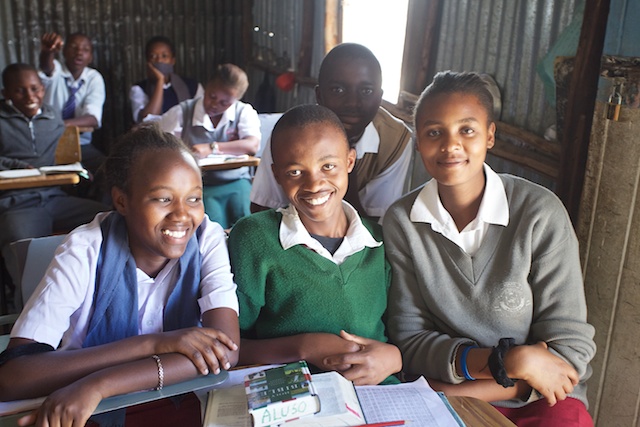
| Photo by Michelle Johnson |
This week at work, I attended a presentation in honor of Women’s History Month, which happens to be in March. The main speaker was a federal court judge who is the first African-American female judge to be appointed to a federal court in the state of Indiana. (Incidentally, it only took 28 years!) The theme of her speech was “empowerment through education,” whether to shatter glass ceilings or break out of the cycle of poverty. As to the latter, she stated that when interviewed about her school in South Africa, Oprah Winfrey remarked that the most powerful weapon we possess in this era to fight poverty is education. I have seen this philosophy lived out in Haiti, where orphaned children are given an education, despite the costs, and in the slums of Nairobi. We were told that the founders of Missions of Hope International (MOHI), the Kenyan organization that has started 14 schools in the slums and beyond for nearly 6,700 kids, were inspired by the plea of families in the slums– “It is too late for us, but please save our children.”
Traditionally, girls in developing countries are not allowed to go to school. Given the gender bias that is prevalent in many societies, it is considered wasteful to educate a girl. The reality is that many families are reticent to send any of their children to school because they are needed to work during the day to provide money for the family. Thus, many boys in developing countries also are not allowed to attend school. However, groups like MOHI are working to change this way of thinking by emphasizing that only through education can the next generation understand that abject poverty is not the only alternative. Certainly, a solid education provides a vast array of opportunities in an economic sense. However, perhaps more importantly, expanding one’s knowledge through intellectual pursuits moves you from a world that is constrained to less than a square mile to one without boundaries. You not only grow to appreciate that there is more to this life, but also you receive the confidence to pursue it. We witnessed this in action at the MOHI schools, where countless students expressed that they want to be doctors, lawyers, journalists, and other professionals when they grow up. While warming my heart, it also brought tears to my eyes to hear so many girls in particular say that they love science (including my Doreen, who wants to be a doctor) and that they love to write. A skill that you can hone even in a darkened shanty in a slum!
I am more than blessed in so many ways when it comes to my own education. Both of my parents were first-generation college graduates and did not limit my sister and I in our intellectual pursuits. I attended a full 12 years of schooling as a child and young adult and pursued not only a college degree, but a graduate degree as well. I belong to a small minority of women in the world who are attorneys. And I am not currently persecuted or prevented from further advancing my education. As a woman who also happens to be a United States citizen, the ability to expand my knowledge is limitless. For all of these reasons and more, I am so thankful that I can now contribute to the education of a nine-year-old girl from Mathare Valley slum who wants to be a doctor when she grows up. I pray that she will see her dream realized and that through that realization, she will be able to come alongside many other girls like her in the future.
 A Life Called to Love